
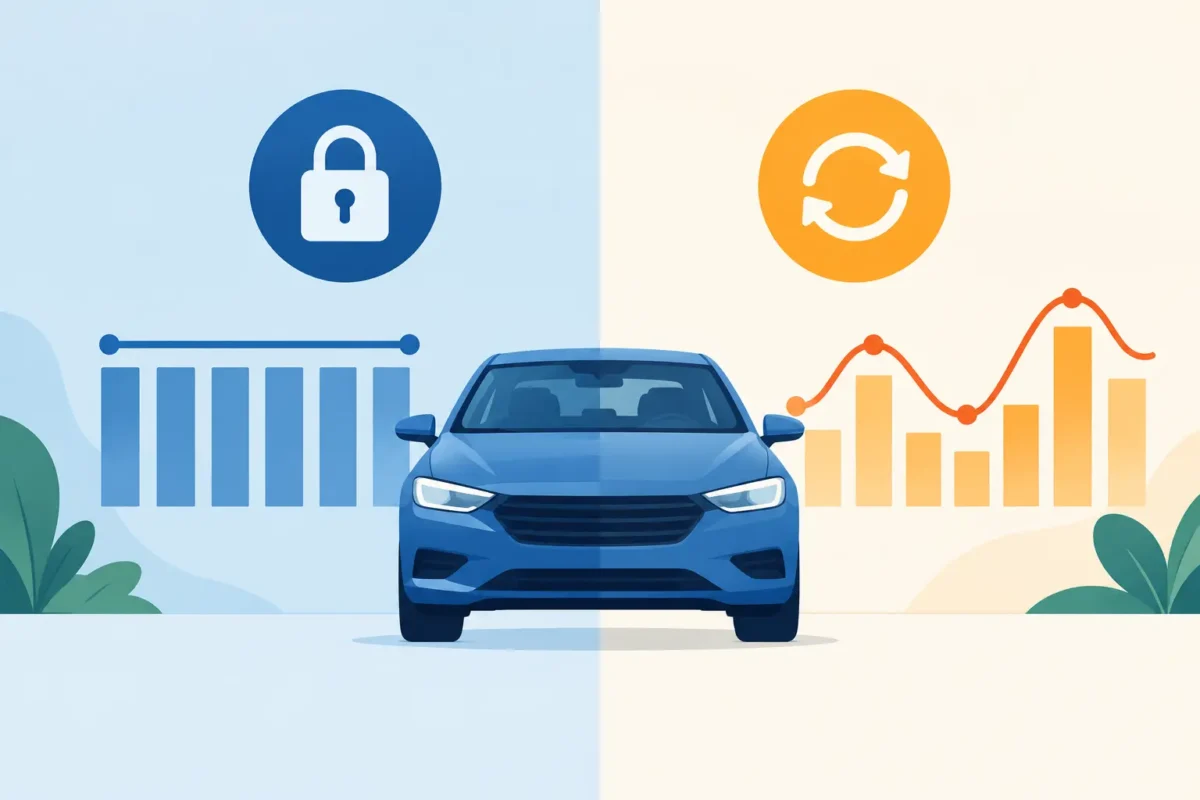
Your car payment should not come with a monthly guessing game. When comparing fixed versus variable auto rates, the key question is simple: do you want the certainty of one predictable payment, or are you comfortable with a rate that could change over time?
For most drivers refinancing an existing auto loan, predictability matters. A fixed rate can make it easier to budget for groceries, rent, insurance, and everything else competing for your paycheck. But variable rates may occasionally start lower, which can make them look appealing at first glance. Knowing how each option works helps you compare offers based on the total impact on your finances, not just the number that catches your eye.
What Is a Fixed Auto Loan Rate?
A fixed interest rate stays the same for the life of your loan. If your loan payment is $425 today, the principal-and-interest portion of that payment remains consistent each month, assuming your loan terms do not change.
That stability is why fixed-rate loans are common in auto financing. You know the annual percentage rate, or APR, when you sign the agreement, and you can estimate exactly how much interest you will pay if you keep the loan through its full term.
A fixed rate can be especially useful if you are working to lower your monthly payment through refinancing. Once you land a rate and term that fit your budget, you have a clear path forward. Rising market interest rates will not increase the rate on your existing fixed loan.
There is a trade-off. Fixed rates may sometimes begin slightly higher than an introductory variable rate. Still, the value of a fixed rate is not just the rate itself. It is the ability to plan around a payment that is not likely to move.
What Is a Variable Auto Loan Rate?
A variable rate can rise or fall during the loan term. It is typically tied to a published financial index, plus a margin set by the lender. If the index changes, your interest rate and payment may change as well.
Variable-rate auto loans are less common than fixed-rate loans, but they can appear through certain financial institutions or specialty lending programs. A variable rate may start below a comparable fixed rate, which can create lower initial payments. That initial savings is the main reason some borrowers consider one.
The risk is that a lower starting rate is not a promise of long-term savings. If market rates rise, your rate can increase. Depending on the loan agreement, your monthly payment could go up, more of each payment could go toward interest, or both. A rate adjustment can be particularly difficult when your household budget already has little room for surprises.
Before accepting a variable loan, read the terms closely. Ask how often the rate may adjust, which index it follows, whether there is a cap on rate increases, and how the lender will calculate your new payment. Those details matter more than a low introductory number.
Fixed Versus Variable Auto Rates: The Real Difference
The difference comes down to certainty versus flexibility. A fixed rate gives you a stable APR and payment schedule. A variable rate gives you the possibility of a lower rate at the beginning, along with the possibility that your costs will increase later.
Neither option is automatically right for every borrower. Your choice depends on your financial priorities, how long you expect to keep the loan, and how much payment change you could realistically handle.
A fixed rate often makes sense when you want to know what your car will cost every month. It can be a strong fit for drivers with a tight budget, families managing several bills, or borrowers who plan to keep their refinance loan for years.
A variable rate may be worth considering only if you understand the adjustment rules and have enough financial flexibility to handle a higher payment. It may also be more attractive to someone who expects to pay off the loan very quickly, before a rate adjustment has much time to affect the total cost. Even then, compare the terms carefully instead of assuming the lower starting rate will save money.
Your APR Is Not the Only Number That Matters
When you refinance, focusing only on the advertised rate can lead to an incomplete comparison. Your payment and total loan cost are shaped by your APR, loan balance, repayment term, and any applicable fees.
For example, extending your repayment term can lower your monthly payment even if the interest rate does not drop much. That can create useful breathing room in your budget. But a longer term may also mean paying more total interest over time. On the other hand, a shorter term can help you pay the vehicle off faster, but it may raise your monthly payment.
The best refinance offer is the one that supports your actual goal. If your priority is immediate monthly savings, a longer term and competitive fixed APR may help. If you are trying to reduce total interest, a shorter term could be the better move if the payment still feels comfortable.
Compare offers using the same loan details
To make a fair comparison, look at each offer using the same remaining balance whenever possible. Then review the APR, monthly payment, number of payments remaining, total estimated interest, and any fees. If one lender quotes a lower payment, check whether it is because of a better rate, a longer term, or both.
Also consider your current loan. If your credit has improved since you financed your vehicle, or if market conditions have changed, refinancing could give you access to better terms than you received at the dealership.
When Refinancing With a Fixed Rate May Help
Refinancing may be worth exploring if your current rate feels high, your payment is straining your budget, or your financial profile has improved. A fixed-rate refinance can help replace uncertainty with a payment you can plan around.
You may want to get a refinance quote if you have been making on-time payments, paid down part of your existing balance, improved your credit, or found that your original loan term no longer fits your needs. You do not have to wait until your current loan becomes unmanageable. Comparing options early can give you more choices.
Keep in mind that refinancing restarts your loan with a new term. If you choose a longer term to lower your payment, make that decision intentionally. Lowering the monthly obligation can be valuable, especially when cash flow is tight, but it is smart to understand the total repayment picture before you finalize anything.
Questions to Ask Before You Choose
A clear loan offer should make it easy to understand what you are agreeing to. Before moving ahead, ask whether the rate is fixed or variable, whether the quoted APR includes applicable fees, and what your payment will be from the first month through the final payment.
If the rate is variable, ask what could cause it to change and how high it could go. If the rate is fixed, confirm that the rate will remain fixed for the entire loan term. You should also ask whether there is a prepayment penalty. Many borrowers like having the option to pay extra toward principal when their budget allows.
The right lender should give you room to review your options without pressure. OpenRoad Lending focuses on making the refinance process easier to understand, so you can evaluate a potential payment and term with your own financial goals in mind.
Choose the Payment You Can Live With
A car loan should support your life, not make every month harder to manage. Fixed versus variable auto rates is not just a technical finance question. It is a decision about how much certainty you want in your budget and how much risk you are willing to take for a potentially lower starting rate.
If a stable payment would help you feel more in control, a fixed-rate refinance may be the better fit. Take a few minutes to compare your current loan with available refinance terms, then choose the option that gives your budget more room to move.