How to Calculate Car Equity Before You Refinance

How to Calculate Car Equity Before You Refinance

Your car may be worth more – or less – than the amount left on your auto loan. Knowing how to calculate car equity puts that number in plain view, so you can make clearer decisions about refinancing, trading in, selling, or simply keeping your current vehicle.

Car equity is not complicated, but using the right numbers matters. Your monthly statement balance is only part of the picture. You also need a realistic estimate of what your vehicle is worth today and your lender’s exact payoff amount.

What Is Car Equity?

Car equity is the difference between your vehicle’s current market value and the amount you still owe on your auto loan.

Car equity = current vehicle value – loan payoff amount

If your vehicle is worth $22,000 and your payoff amount is $17,500, you have $4,500 in positive equity. If it is worth $15,000 and your payoff is $17,500, you have $2,500 in negative equity.

Positive equity means you own a portion of the car outright. Negative equity, sometimes called being upside down on a loan, means the loan balance is greater than the car’s value. Neither result automatically tells you what to do next, but both affect your options.

How to Calculate Car Equity in Three Steps

1. Find your vehicle’s current value

Start with an estimated market value for your specific vehicle. Use reputable vehicle valuation tools and enter the year, make, model, trim, mileage, ZIP code, and condition as accurately as possible. A well-maintained vehicle with lower mileage may be worth more than a similar model nearby. Accident history, worn tires, mechanical issues, and cosmetic damage can reduce its value.

Pay attention to the type of value you are viewing. A private-party value is often higher than a trade-in value because selling directly to another buyer takes more time and effort. A dealer may offer less than a private buyer, but a trade-in can be faster and more convenient. For an equity calculation tied to a trade-in, use a realistic trade-in estimate rather than the highest advertised retail price.

If you are refinancing and plan to keep the car, use a reasonable current market estimate. Lenders may use their own approved valuation sources, so their figure can differ from the number you find online.

2. Request your exact loan payoff amount

Your payoff amount is the total needed to satisfy your loan on a specific date. It can be different from the principal balance shown on your statement because interest may accrue daily. Depending on your loan and state, it may also include a small processing or release fee.

You can usually find a payoff quote through your lender’s online account portal, mobile app, or customer service line. Ask how long the quote is valid. Many payoff quotes are good for a limited number of days, which matters if you are selling, trading, or refinancing soon.

Do not assume the amount listed as “remaining balance” is your payoff. When the difference is only a few dollars, it may not change your plans. When you are close to having negative equity, though, an accurate payoff quote can make a real difference.

3. Subtract the payoff from the value

Once you have both numbers, subtract your payoff amount from your car’s estimated value.

For example, assume your 2021 SUV has an estimated trade-in value of $19,200. Your lender provides a payoff quote of $16,850.

$19,200 – $16,850 = $2,350 in positive equity

That $2,350 does not necessarily arrive as cash in your hand. If you trade the vehicle, it may be applied toward your next purchase, taxes, or related transaction costs. If you sell privately, you would use sale proceeds to pay off the lender and keep the remaining amount after any selling costs.

Now consider the opposite scenario. Your sedan is worth an estimated $12,800, but the payoff quote is $15,100.

$12,800 – $15,100 = -$2,300 in negative equity

You would need to cover that $2,300 difference if you sell or trade the vehicle, unless it is rolled into a new loan. Rolling negative equity into another loan can increase the amount financed and may keep you underwater longer, so it deserves careful consideration.

Why Your Car Equity Can Change Quickly

Car equity is a moving number. Your payoff generally drops as you make payments, but your vehicle’s value can also change with age, mileage, local demand, fuel prices, seasonality, and the overall used-car market.

Early in a loan, more of each payment may go toward interest than principal. That can make the balance fall slowly at first. A long loan term, a small down payment, high interest rate, or negative equity from a prior vehicle can also make it harder to build equity.

On the other hand, paying extra toward principal can help reduce your payoff faster, provided your loan does not have a prepayment penalty. Keeping mileage in check and maintaining the vehicle may support its resale value, although normal depreciation is difficult to avoid.

How Equity Affects Auto Refinancing

Positive equity can be helpful when you refinance, but it is not the only factor. Lenders generally consider the vehicle, your remaining loan amount, credit profile, income, payment history, and loan-to-value ratio, often called LTV.

LTV compares how much you want to finance with the vehicle’s value. For example, if the refinance amount is $18,000 and the car is valued at $20,000, the LTV is 90 percent. A lower LTV can present less risk to a lender. A higher LTV may limit available terms or affect approval options.

Negative equity does not always prevent refinancing. It depends on the lender’s guidelines, the size of the gap, the vehicle’s age and mileage, and the rest of your application. If refinancing can lower your interest rate or monthly payment, it may still be worth reviewing your options. Just remember that extending your loan term can lower the payment while increasing the total interest paid over time.

A refinance quote lets you compare the new payment, rate, term, and total cost before making a decision. At OpenRoad Lending, the goal is to make that comparison easier for eligible drivers who want to explore better auto loan terms without added guesswork.

Equity Matters Differently When You Sell or Trade In

If you have positive equity and trade in your car, the dealer can typically apply that value toward your next vehicle. Ask for the trade-in offer and the purchase price of the next vehicle separately. Keeping those figures separate makes it easier to see whether you are getting a fair deal.

If you sell privately, contact your lender before accepting payment. Since the lender may hold the title until the loan is paid, you will need a clear payoff and title-transfer process. Never promise a buyer a timeline you have not confirmed with your lender.

With negative equity, slowing down can be the financially stronger move. Keeping the car for a while, making extra principal payments when your budget allows, or refinancing into a better rate may help shrink the gap. The right choice depends on your payment, vehicle needs, and the cost of the alternative.

Avoid These Common Car Equity Mistakes

The most common mistake is using an overly optimistic vehicle value. A retail listing for a similar car is not the same as a guaranteed trade-in offer or private-sale price. Be honest about condition and mileage so your estimate is useful.

Another mistake is forgetting the payoff quote expires. If you wait several weeks, request an updated amount before finalizing a sale, trade, or refinance. Also, do not focus only on the monthly payment. A lower payment can help your budget now, but a longer term may mean paying more interest overall.

Finally, remember that equity is one piece of your financial picture. Your emergency savings, insurance coverage, upcoming repairs, and transportation needs all matter. A car with modest negative equity may still be worth keeping if it is reliable and the payment fits your budget.

Check Your Number Before You Make a Move

Calculate your equity before responding to a trade-in offer, listing your car for sale, or applying to refinance. Then revisit the number when you receive a firm offer or payoff quote. A few minutes of preparation can help you avoid carrying an unexpected balance into your next decision – and give you more confidence in the path that best supports your monthly budget.
Read more
Car Loan Savings Calculator Tips That Work

Car Loan Savings Calculator Tips That Work

A lower payment can feel like immediate relief, especially when groceries, insurance, and everyday bills keep climbing. But the best car loan savings calculator tips go beyond finding the smallest number on the screen. They help you see what you may pay over time, how a refinance could change your budget, and whether a new loan truly puts you in a stronger position.

A calculator gives you estimates, not a final loan offer. Still, a few minutes with the right numbers can help you ask better questions, compare options with confidence, and identify whether refinancing may be worth exploring.

Start With Your Current Loan Details

A calculator can only be as useful as the information you enter. Before comparing refinance scenarios, pull out your latest auto loan statement or sign in to your lender account. You will want your current payoff balance, interest rate, monthly payment, and the number of payments remaining.

Your payoff balance matters more than the amount you originally borrowed. If you financed $28,000 two years ago, for example, that original number is no longer the amount a refinance lender would need to pay off. The remaining balance is what counts.

Be careful with the term, too. A 60-month loan that has been paid for 18 months has about 42 payments left. Entering the original 60-month term can make your current payment and total-interest comparison misleading.

If you cannot find every detail, start with the numbers you know. A refinance specialist can help clarify the information later, but an accurate starting point produces a more useful estimate.

Compare More Than the Monthly Payment

Lowering your monthly payment is a valid goal. It can create breathing room in a household budget, help you get caught up on other expenses, or give you more flexibility when life changes. But payment alone does not tell the whole story.

A longer repayment term often lowers the payment because the balance is spread across more months. That may be the right choice when cash flow is your top priority. The trade-off is that paying for longer can increase the total interest paid, even with a better rate.

When reviewing calculator results, look at these three figures together: the estimated monthly payment, the estimated total interest, and the estimated payoff date. That combination shows whether you are reducing both your rate and your overall borrowing cost, or mainly extending the time it takes to repay the loan.

For example, imagine you have a $16,000 payoff balance, a 12% APR, and 36 months remaining. A refinance at a lower rate could reduce your payment while also cutting interest if you choose a similar term. Choosing a substantially longer term may bring the payment down further, but the total cost depends on the new rate and how long you keep the loan.

Car Loan Savings Calculator Tips for Better Estimates

Small changes in your inputs can create a very different result. Use these practical checks before treating any savings estimate as a decision-making number.

Use your actual payoff amount

Your current balance may not match your next payoff amount exactly because interest accrues daily and some lenders may include a small payoff adjustment. Use the most current figure available, then treat the result as an estimate until you receive final loan terms.

Enter APR, not just the interest rate you remember

APR is the annual percentage rate used to show the cost of borrowing. If your statement lists an APR, use that figure. Do not guess based on a rate from years ago or use a credit card rate by mistake. A one- or two-point difference can meaningfully affect projected savings.

Test two or three terms

Do not stop after entering one new term. Compare a shorter term, a term close to your remaining loan length, and a longer term. A shorter term may cost more per month but save more interest. A longer term may support your current budget better. The right answer depends on what you need most right now.

Include relevant fees in the comparison

Some refinance loans may involve fees, and those costs can affect the overall value of the loan. If a calculator lets you add fees, include them. If it does not, keep them in mind when comparing estimates with an actual offer.

Avoid assuming every dollar of payment reduction is permanent savings

If your payment falls from $520 to $410, that $110 can help your monthly budget immediately. However, the lifetime savings may be different if the new loan extends your repayment period. Think of monthly relief and total interest savings as two related, but separate, goals.

Run a Refinance Scenario That Fits Your Life

The most helpful calculator comparison is not always the one with the lowest payment. It is the one that matches your financial priorities.

If your current loan has a high interest rate and you have improved your credit profile since taking it out, start by testing a refinance term close to the number of months you have left. This is often the clearest way to see how a lower rate could reduce interest without resetting your payoff date too far into the future.

If your budget is tight, test a longer term as well. A lower monthly payment may be valuable even if the total interest is not the lowest possible outcome. There is no one-size-fits-all choice. What matters is understanding the trade-off before you commit.

You can also test a middle-ground option. Maybe a 48-month term lowers your payment enough to help your budget without pushing your final payment date out as far as a 60- or 72-month option. The calculator is there to help you see those choices side by side.

Watch for Details a Calculator Cannot Know

Online estimates are useful, but they cannot account for every part of your situation. Your final refinance rate and terms may depend on your credit history, income, vehicle age and mileage, loan-to-value ratio, state requirements, and lender guidelines.

Your vehicle’s value matters because refinancing generally involves the amount owed compared with what the vehicle is worth. If you owe significantly more than the vehicle’s value, your options may be more limited. That does not mean you should avoid checking – it means you should review your full situation rather than relying on a calculator alone.

Also, consider what happens to optional products connected to your existing loan. Vehicle service contracts, GAP coverage, and other protection products may have their own terms. Ask questions so you understand whether coverage continues, can be canceled, or needs to be replaced when you refinance.

Turn Your Estimate Into a Smart Next Step

Once you have run the numbers, write down the scenario that feels most useful: your current payment and rate, your target payment, your preferred payoff timeline, and the estimated interest difference. This keeps the conversation focused when you request a refinance quote.

A quote is where estimates become more specific. Review the proposed APR, term, payment, total amount financed, and any fees before deciding. If the payment is lower because the term is longer, make sure that outcome works for your plan. If the rate is lower and the term is similar, look closely at the potential interest savings.

At OpenRoad Lending, refinancing is designed to be a straightforward way for eligible vehicle owners to explore lower payments, better rates, or loan terms that fit their needs. A quick estimate can help you begin with a clear goal, while a personalized quote helps you evaluate the real numbers.

The best calculator result is not simply the lowest payment on the page. It is a loan choice you understand, can comfortably manage, and feel good about making month after month.

Read more
A GAP Coverage Claim Example With Real Numbers

A GAP Coverage Claim Example With Real Numbers

A serious accident can turn a dependable car into an unexpected financial problem in one day. This GAP coverage claim example shows why: your auto insurer may pay the vehicle’s current value, while your loan payoff can be thousands of dollars higher. GAP coverage may help with that difference, subject to the terms, limits, and exclusions in your agreement.

A GAP Coverage Claim Example With Real Numbers

Imagine you bought a vehicle for $32,000 and financed most of the purchase. After taxes, fees, and interest, your original loan amount was $34,500. Two years later, you still owe $26,000 on the loan.

Then the vehicle is stolen and never recovered, or it is damaged beyond repair in an accident. Your comprehensive or collision insurer declares it a total loss and determines the vehicle’s actual cash value is $21,500. After subtracting your $1,000 insurance deductible, the insurer sends $20,500 to your lender.

Your loan balance does not disappear just because the vehicle is gone. In this example, you owed $26,000, but the insurance payment was $20,500. That leaves a $5,500 shortfall.

If you have eligible GAP coverage, the provider may pay all or part of that $5,500 deficiency. The final amount depends on your specific contract. Some plans may also cover part of your deductible, while others do not. Certain loan charges, late fees, missed payments, extended warranty balances, and other add-ons may be excluded.

The key number is not what you originally paid for the vehicle. It is the difference between your covered insurance settlement and the payoff amount on the date of loss.

Why a GAP Balance Can Happen So Quickly

Vehicles generally lose value faster in the first few years of ownership than a typical auto loan balance declines. That gap can be larger when you made a small down payment, financed for a longer term, rolled negative equity from a previous loan into the new loan, or included taxes and fees in your financing.

For example, a 72- or 84-month loan can make the monthly payment easier to manage, but the balance may remain high for longer. That does not make a longer term wrong. It simply means your loan payoff and your vehicle’s market value may not move at the same pace.

A total loss is also more common than many drivers expect. It does not always mean a vehicle is completely destroyed. If repair costs approach or exceed the insurer’s threshold compared with the vehicle’s value, the insurer may total it. A theft that is not recovered can lead to the same result.

What Happens When You File a GAP Claim

A GAP claim usually starts after your primary auto insurer has completed its total-loss evaluation. GAP is not a replacement for comprehensive or collision insurance. Your auto policy is typically the first coverage involved, and GAP addresses a qualifying remaining balance afterward.

The process often follows a straightforward sequence. First, report the accident or theft to your auto insurer and, for theft, law enforcement. Next, notify your lender and GAP administrator as soon as you learn the vehicle may be a total loss. They can tell you what forms and documents are required.

After the insurer issues its settlement, your lender provides the payoff information. The GAP administrator compares the settlement, the deductible if eligible, and the outstanding loan balance against the terms of your agreement. If the claim is approved, the GAP payment generally goes to the lender, not directly to you.

That last detail matters. GAP is designed to reduce or eliminate a qualifying loan deficiency. It does not usually provide money for a replacement vehicle, a down payment on another car, or missed work after an accident.

Documents that can keep your claim moving

Requirements vary, but claim administrators commonly ask for your total-loss settlement statement, your loan payoff statement, the GAP agreement or contract number, and an itemized breakdown of the loan balance. You may also need a copy of your insurance declarations page, police report for a theft, repair estimate, and proof that the insurance settlement was paid.

Keep copies of every document, including emails and notes from phone calls. If the lender’s payoff figure changes because of daily interest, ask for an updated statement promptly. Missing paperwork is one of the most common reasons a claim takes longer than expected.

What GAP May Not Cover

GAP can be valuable protection, but it is not a blank check. Before assuming a balance will be paid, review the contract carefully and ask the administrator about any limits that apply to your situation.

Many agreements exclude amounts caused by missed payments, late charges, collection costs, or loan modifications made after the coverage started. Coverage may also exclude balances related to products that were financed with the vehicle, depending on the plan. If you received money back from your insurer for unused service contracts or other canceled products, that refund could be applied to the loan balance before GAP calculates any payment.

Some GAP plans have a maximum benefit or cap the covered deficiency at a percentage of the vehicle’s value. Others may not cover a deductible at all. There can also be eligibility rules involving loan-to-value limits, commercial use, rideshare or delivery use, salvage titles, or lapses in required auto insurance.

The practical takeaway is simple: do not wait for a total loss to read the fine print. Know what you bought, what it covers, and which circumstances could reduce a payment.

How to Prepare Before a Total Loss Happens

The best time to organize claim information is while everything is still routine. Save your GAP agreement, loan documents, insurance declarations, and lender contact information in a place you can access without your vehicle. A secure digital folder can make a stressful situation easier to manage.

You should also maintain the insurance coverage required by your lender and make payments on time. A lapse in comprehensive or collision coverage can create a much larger problem because GAP generally depends on a valid primary insurance settlement.

Review your loan balance at least a few times each year. If you are significantly upside down, refinancing may be worth exploring. A lower interest rate, a better term, or a payment that better fits your budget can help you make steady progress on the balance. Refinancing does not erase negative equity, and it is not right for every borrower, but it can be a useful way to improve your overall loan terms.

Questions to Ask About Your Own Coverage

If you already have GAP, call the administrator or lender and ask whether your agreement covers your current loan type and vehicle use. Confirm whether there is a maximum payout, whether the deductible is included, and whether any financed add-ons are excluded. Ask what deadline applies for reporting a claim, too.

If you are considering GAP with a vehicle loan or refinance, compare the actual cost with the protection provided. The value depends on how much you owe compared with what the vehicle is worth, how long you expect to finance it, and how much financial strain a remaining balance would cause after a total loss.

A GAP coverage claim example makes the purpose clear: it can help prevent a totaled or stolen car from leaving you with a loan payment for a vehicle you no longer have. Keep your documents organized, understand your coverage before you need it, and make sure your auto loan still supports the financial goals you have for the road ahead.

Read more
Refinancing Versus Deferral: Which Helps More?

Refinancing Versus Deferral: Which Helps More?

A car payment can feel manageable one month and suddenly strain the budget the next. If your income has changed, an unexpected bill came up, or your current rate simply feels too high, you may be weighing refinancing versus deferral. Both can provide breathing room, but they work in very different ways – and one may be a better fit for your situation.

Deferral is generally a short-term payment relief option offered by your current lender. Refinancing replaces your existing auto loan with a new one, ideally with terms that better support your budget. Understanding the difference can help you make a move that brings relief now without creating more pressure later.

Refinancing Versus Deferral: The Key Difference

A payment deferral lets you postpone one or more scheduled loan payments, subject to your lender’s policies and approval. The skipped payment is usually moved to the end of the loan. That means your due date may be pushed back, and you may keep paying interest for longer.

Auto refinancing is different. A new lender pays off your existing loan, and you begin making payments on a new loan with a new interest rate, monthly payment, and repayment term. Depending on your credit profile, vehicle, remaining balance, and loan terms, refinancing may lower your monthly payment, reduce your interest rate, or both.

The simplest way to think about it is this: deferral pauses a problem temporarily. Refinancing may change the loan itself.

When a Payment Deferral May Make Sense

Deferral can be useful when a financial setback is truly temporary. Maybe you are between jobs but have accepted a new position, dealing with a short-term medical expense, or waiting for a one-time payment to arrive. If you expect your budget to return to normal soon, postponing a payment may help you avoid missing it.

Before agreeing to a deferral, ask your lender exactly what will happen. Will interest continue to accrue during the deferred period? Will the payment be added to the end of the loan? Does the lender charge a fee? Will the change be reported to the credit bureaus, and if so, how?

Those details matter. A deferred payment is not usually forgiven. You still owe the amount, and the total cost of borrowing can increase if interest continues to build. Your loan may also last longer than you originally planned.

Deferral may not solve the problem if your regular payment is already too high for your ongoing budget. Pushing this month’s payment back can help in an emergency, but the same payment returns next month. If the underlying payment no longer fits, a longer-lasting adjustment may be worth considering.

How Auto Loan Refinancing Can Create Lasting Relief

Refinancing may be worth exploring when your goal is more than a one-month pause. A lower interest rate can reduce the amount you pay over the life of the loan. A longer repayment term can lower the required monthly payment, which may free up room for groceries, insurance, savings, or other essential expenses.

Your results depend on the offer you qualify for. A lower monthly payment is valuable, but it is smart to look at the full picture: the annual percentage rate, the number of payments, the total finance charge, and whether the new loan has fees. Extending your term can reduce your payment while increasing total interest paid over time. That trade-off may still make sense if dependable monthly cash flow is your top priority.

Refinancing is often most attractive when your credit has improved since you took out your current loan, rates have become more favorable, or you accepted dealer-arranged financing without much time to compare options. It can also be a practical choice if you have a high-rate loan and a vehicle that still meets a refinance lender’s eligibility requirements.

At OpenRoad Lending, the refinancing process is designed to make it easier to see whether better terms may be available. You can start with a no-obligation quote and review your options before deciding whether a new loan works for your budget.

Compare More Than the Monthly Payment

It is natural to focus on the number due each month. If your payment drops by $75 or $100, that can make an immediate difference. Still, the best decision comes from comparing the complete cost and structure of each option.

With a deferral, find out how much interest may be added and how far your final payoff date moves. With refinancing, compare your current payoff amount and remaining term against the new loan’s APR, term, payment, and estimated total cost.

Also consider how long you plan to keep the vehicle. If you expect to sell or trade it soon, extending your loan significantly could leave you owing more than the vehicle is worth. If you plan to keep it for years and need a payment that fits comfortably, a refinance loan with a manageable term may offer more stability.

A lower payment should not require you to ignore the rest of your financial needs. The right loan payment is one you can make consistently while still handling the expenses that keep your household moving.

What About Your Credit?

If you are worried about missing a payment, contact your current lender before the due date. A formal deferral arrangement may be treated differently than simply paying late, but reporting practices vary by lender. Get the terms in writing and ask how the agreement could affect your credit file.

Applying to refinance can involve a credit review. Credit inquiries and new accounts can affect credit scores, although the impact varies by person and scoring model. More importantly, a refinance loan may help you maintain a positive payment history if it gives you a payment you can reliably afford.

No option can guarantee a specific credit outcome. What you can control is acting early, reading the terms, and choosing a payment structure that is realistic for your income and expenses.

A Quick Way to Decide

Deferral may be the better route if you have a short, clearly defined cash crunch and are confident you can resume your normal payment soon. It can provide immediate relief without replacing the loan.

Refinancing may be the stronger option if your current payment is consistently too high, your interest rate is unfavorable, or your financial situation has improved since you first financed the vehicle. It is a chance to seek a loan that better reflects where you are now.

In some situations, the answer may be neither. If the loan balance is far above the vehicle’s value or your income has dropped for the long term, it may help to speak with your lender or a qualified financial counselor about all available options. The goal is not just to get past one due date. It is to choose a path you can sustain.

Take the Next Step Before You Feel Behind

Waiting until a payment is already overdue can narrow your options and add stress. Review your current statement, check your payoff amount, and write down the payment you can realistically afford each month. Then compare that number with what a deferral would change and what a refinance offer could provide.

A temporary pause can be helpful when life throws you a short-term curveball. But if your auto loan has been putting pressure on your budget month after month, exploring refinancing could be the step that helps your payment feel manageable again.

Read more
5 Refinance After Bankruptcy Examples for Car Owners

5 Refinance After Bankruptcy Examples for Car Owners

A bankruptcy filing can change your financial picture, but it does not mean your current auto loan is permanent. These refinance after bankruptcy examples show how real-life factors – payment history, vehicle value, credit progress, and timing – can affect your options and your potential monthly payment.

For many car owners, refinancing is not about chasing a perfect credit score. It is about finding a more manageable loan after taking meaningful steps to rebuild. The right time to apply depends on your situation, and approval or savings are never guaranteed. Still, a better rate, lower payment, or more workable term may be possible sooner than you expect.

What Lenders Consider After Bankruptcy

Bankruptcy remains on a credit report for a period of time, but lenders look at more than the filing itself. They may evaluate whether the bankruptcy has been discharged or completed, how long it has been since the filing, and how you have handled credit since then.

Your vehicle and current loan matter, too. A lender will generally review the vehicle’s age, mileage, value, remaining payoff amount, and your payment record. A reliable record of on-time auto payments can be particularly meaningful because it demonstrates how you manage the exact debt you want to refinance.

Income also plays a major role. Stable, verifiable income can help show that a new monthly payment fits your budget. If your income has improved since you originally financed your vehicle, refinancing may be worth exploring even if your credit is still a work in progress.

5 Refinance After Bankruptcy Examples

These examples are hypothetical. Actual rates, terms, payments, and approval decisions vary by lender, credit profile, vehicle, loan balance, income, and state requirements.

1. Chapter 7 discharge with a year of on-time payments

Marcus received a Chapter 7 discharge 14 months ago. He kept his car throughout the process and made every payment on time. His original loan balance is now $16,000, with 48 months remaining at an 18% annual percentage rate. His payment is about $470 per month.

During the past year, Marcus paid down a credit card, avoided new late payments, and built a more consistent credit profile. If he qualified to refinance the remaining balance at 10% for the same 48-month term, his payment could fall to about $406 per month. That is roughly $64 more room in his monthly budget without extending the payoff date.

The key in this example is not simply that time passed after bankruptcy. Marcus also showed a lender steady payment behavior and a loan balance that made sense for his vehicle’s value.

2. A lower rate without adding years to the loan

Danielle filed Chapter 7 two years ago and has rebuilt carefully. Her current loan has a $16,800 balance, 48 months remaining, and a 14% rate. Her payment is about $459 per month. Her income is stable, and the car has held its value well.

If Danielle were approved for a 48-month refinance at 9%, her payment could drop to about $418 per month. The monthly difference may seem modest, but keeping the same remaining term means she could also reduce the interest paid over the life of the loan.

This is an example of refinancing for better terms, not just the lowest possible payment. If a borrower can afford the current payment, maintaining or shortening the term can be worth considering because a longer term may increase total interest even when the monthly payment falls.

3. Chapter 13 repayment plan and the need to check first

Andre is making payments under a Chapter 13 repayment plan. He has a high-rate auto loan and wants a lower payment because his household expenses increased. Unlike a completed Chapter 7 case, an active Chapter 13 plan can involve additional rules and approvals.

Before applying, Andre should review his plan and speak with his bankruptcy attorney or trustee about whether refinancing requires permission. Some lenders may not offer refinancing while a Chapter 13 case is active, while others may consider an application if the proper steps are completed.

If refinancing is allowed, Andre may find that extending the term lowers his payment. For example, moving from a shorter remaining term to a longer one could free up monthly cash flow. That relief can be useful, but it comes with a trade-off: paying the loan longer may increase the total amount of interest paid. The best decision is the one that supports his court-approved plan and his household budget.

4. Recent discharge, but not enough rebuilding time yet

Tasha’s Chapter 7 bankruptcy was discharged three months ago. She needs her vehicle for work, and her current interest rate is high. She applies for refinancing right away but receives an offer that does not improve her payment or rate enough to justify switching.

That does not mean refinancing is off the table forever. Tasha may decide to wait several months while she makes every auto payment on time, keeps credit card balances low, and avoids unnecessary applications for new credit. She can also check that her credit reports accurately show the discharged debts and current account status.

In Tasha’s case, waiting may be the smarter financial move. A refinance only makes sense when the new loan provides a clear benefit, such as a lower payment, better rate, more suitable term, or a combination of those outcomes.

5. Good payment history, but too much owed on the vehicle

Luis completed bankruptcy more than two years ago and has made his car payment on time ever since. His credit has improved, and his income is dependable. On the surface, he appears ready to refinance.

The challenge is his loan balance. He owes $22,000, but his vehicle may be worth closer to $15,000. Because the amount owed is substantially higher than the car’s value, a lender may be unable to approve a refinance or may offer terms that do not provide much savings.

Luis might benefit from continuing to reduce the balance before applying again. If possible, making extra principal payments can improve the loan-to-value picture. This example shows why a stronger credit profile alone does not determine refinance eligibility. The vehicle and payoff amount matter just as much.

How to Tell Whether It Is Worth Applying

Start with the numbers you know: your current payoff amount, interest rate, monthly payment, remaining term, and vehicle information. Then consider what you need most. If your priority is monthly breathing room, a longer term could help lower the payment. If your priority is paying less interest, a lower rate with the same or shorter term may be the better target.

It also helps to take an honest look at recent credit behavior. A string of on-time payments, stable income, and lower revolving balances can strengthen an application. On the other hand, a recent late payment, unstable income, or a loan balance well above the vehicle’s value can limit your choices.

Avoid focusing only on the advertised rate. Compare the proposed monthly payment, the number of months you will be paying, and the total cost of the new loan. A lower payment can be a real win when cash flow is tight, but you should understand the trade-off before accepting a longer term.

A Simple Next Step for Car Owners

You do not need to guess whether your bankruptcy automatically disqualifies you. Getting a refinance quote can help you see what may be available based on your current situation, with no obligation to move forward. OpenRoad Lending helps eligible car owners explore refinancing options through a straightforward online process and support from refinance specialists.

Your financial history is one part of the picture, not the whole story. If you have protected your vehicle, made steady progress, and need a loan that better fits your life now, it may be worth seeing whether refinancing can give your budget a little more room.

Read more
Are Online Refinance Applications Safe? What to Check

Are Online Refinance Applications Safe? What to Check

Your current car payment may be taking more out of your budget than it needs to. If you have found a better rate or want a lower monthly payment, applying online can be a convenient first step. But are online refinance applications safe? They can be, provided you work with a legitimate lender and take a few smart precautions before sharing personal information.

A secure online application can save time, help you compare refinance options, and move you closer to better loan terms without making another trip to a branch. The key is knowing what a trustworthy lender looks like, what information they should request, and when to stop if something does not feel right.

Are online refinance applications safe when you choose the right lender?

Online refinancing is a normal part of consumer lending. Reputable lenders use secure technology and established procedures to protect the information needed to review an auto refinance application. That information may include your name, address, income, vehicle details, current loan balance, and permission to review your credit.

Safety depends less on whether the application is online and more on who operates it. A legitimate lender will clearly identify its business, explain how it uses your information, and provide ways to reach real customer support. It should not pressure you to act immediately, hide its terms, or make guarantees that sound too good to be true.

Start by looking beyond a polished website. Check for a clear company name, physical business details, customer service contact information, privacy disclosures, and a history of serving borrowers. Trust signals such as accreditation, established customer reviews, and clear explanations of the refinance process can also help you make a more confident decision.

What a secure refinance application should do

Before entering your information, take a close look at the website itself. The web address should begin with “https,” and your browser should show a lock icon near the address bar. These signs indicate that information sent between your device and the website is encrypted. They are not the only signs of a trustworthy company, but they are a basic first check.

A responsible lender should also tell you what happens next. For example, it should explain whether getting a quote affects your credit, what documents may be required, and whether an offer is final or subject to verification. Clear communication matters because refinancing involves a meaningful financial decision, not just a quick online form.

Be cautious if a site asks for information that does not make sense for an auto refinance quote. You may need to provide personal and financial details as the process moves forward, but you should understand why each item is requested. A lender that offers an initial quote without requiring every sensitive detail right away may give you room to evaluate your options before proceeding.

At OpenRoad Lending, borrowers can start the refinance quote process without providing a Social Security number at the initial stage. That can make it easier to explore potential savings while you decide whether refinancing is right for your situation.

Red flags that deserve a second look

Most online lenders are not out to scam you, but scammers often copy the language and appearance of real financial companies. Slow down if you encounter messages or websites with warning signs like these:

  • A lender promises approval regardless of your credit, income, vehicle, or loan details.
  • You are asked to pay an upfront fee before receiving a loan or completing a refinance.
  • The company demands payment by gift card, wire transfer, cryptocurrency, or a person-to-person payment app.
  • An email or text asks you to click a link and provide account details without giving you a way to independently verify the sender.
  • The website has misspellings, vague contact details, or a web address that is slightly different from the lender’s known name.

A legitimate refinance lender may have eligibility requirements, and not every applicant will qualify for the same rate or payment. That is normal. Real offers are based on factors such as credit profile, vehicle age and mileage, remaining loan balance, income, and the terms of your existing loan.

Also be careful with unsolicited calls, texts, and emails. Even if the message mentions refinancing or a lower payment, do not assume it came from a lender you recognize. Instead of using the link or phone number in the message, find the company through your own search and contact it through the information on its official website.

Protect your information while you apply

Your own habits matter, too. Apply using a private, password-protected home network or cellular connection, not public Wi-Fi at a coffee shop, airport, or hotel. Public networks can create unnecessary risk when you are entering financial information.

Use a strong, unique password for any account you create during the process. Avoid saving passwords or sensitive documents on a shared computer. If you upload proof of income, insurance, registration, or payoff information, make sure you are on the lender’s official application portal before submitting anything.

It is also smart to keep an eye on the emails you receive after applying. Legitimate lenders may contact you to request documents or explain your next steps. Still, do not send sensitive information in response to an unexpected email without confirming that the request is real. When in doubt, call the lender using the phone number listed on its official site.

Understand the credit check before you submit

Many borrowers worry that applying online automatically hurts their credit. The truth is more specific. Some lenders can provide preliminary information through a soft credit inquiry, which typically does not affect your credit score. A lender may later need a hard credit inquiry to finalize an offer or complete the loan process. Hard inquiries can have a small, temporary effect on your score.

The safe approach is simple: read the lender’s disclosures and ask how it handles credit inquiries before you submit. A reputable lender should explain whether your request is a soft pull, a hard pull, or a process that may involve both at different stages.

You should also review the refinance offer itself, not just the advertised rate or monthly payment. A lower payment can be helpful for cash flow, especially when your budget is tight. But if the new loan extends your repayment term significantly, you could pay more interest over the life of the loan. The right refinance option balances the payment you need now with the total cost and term you are comfortable accepting.

Questions to ask before accepting an offer

Once you receive an offer, give yourself time to read it. Confirm the interest rate, annual percentage rate, monthly payment, loan term, estimated total payments, and any applicable fees. Ask whether your current lender charges a prepayment penalty, although many auto loans do not. You will also want to verify how and when the old loan will be paid off.

If a refinance specialist is available, use that support. A good conversation can clarify whether the payment shown reflects your goals and whether there are documents still needed to complete the process. You should never feel rushed into accepting an offer you do not understand.

Is it safer to refinance with a bank than an online lender?

Not necessarily. A bank, credit union, and online lender can all use secure processes. What matters is whether the company is legitimate, transparent, reachable, and careful with consumer information. Evaluate the lender’s practices rather than assuming one delivery method is automatically safer.

Can refinancing save money if I have less-than-perfect credit?

It depends on your current rate, your credit profile today, the value of your vehicle, and the terms available to you. Even if your credit is not perfect, refinancing may still offer a lower payment or a more manageable term. Compare the full offer before deciding.

What should I do if I think I shared information with a scammer?

Contact your bank or financial institutions right away, change affected passwords, and monitor your credit reports and accounts for unfamiliar activity. If you shared vehicle or loan account details, contact your current lender as well. Acting quickly can help limit potential damage.

A safer refinance experience starts with a lender you can verify and a process you understand. Take a few minutes to check the company, read the disclosures, and protect your information. Then you can focus on the part that matters most: finding out whether a better auto loan payment or rate could give your budget more breathing room.

Read more
How Refinance Payment Dates Work for Auto Loans

How Refinance Payment Dates Work for Auto Loans

Your current car payment is due next week, but you have just been approved to refinance. Do you pay the old lender, wait for the new loan, or assume the payment disappears? This is where refinance payment dates can get confusing – and where a simple timing mistake can lead to a late fee or credit reporting issue.

The safest rule is straightforward: keep making payments to your current lender until you receive confirmation that the old loan has been paid off. Refinancing can lower your payment, improve your rate, or give you terms that better fit your budget. It does not automatically erase a payment that is already due while the transaction is being completed.

Why refinance payment dates can change

An auto refinance replaces your existing loan with a new one. The new lender pays off the balance owed to your current lender, and you begin making payments under the new loan agreement. Because these are two separate accounts, there can be a short period when you are waiting for the payoff to post and for your first new due date to arrive.

The exact timing depends on several details: when you finalize your refinance documents, how quickly the payoff is sent and processed, whether a payment is due on your old loan during that window, and the payment schedule established by the new lender.

Many borrowers expect a refinance to work like moving a bill from one company to another overnight. In reality, account updates and payoff processing take time. Planning for that overlap protects your payment history and keeps the process less stressful.

Do I still pay my old lender during refinancing?

Usually, yes. If your current payment is due before your old lender confirms the loan is paid in full, make that payment as scheduled. Do not stop paying just because you were approved, received a quote, or signed documents.

Approval is not the same as funding. Even after a refinance is finalized, your current lender may need time to receive and apply the payoff. Until the account shows a zero balance or paid-off status, you remain responsible for the existing loan.

If you make a payment that turns out to be more than the final amount owed after the payoff posts, your previous lender may issue a refund for the overage. Processing policies vary, so review your old lender’s communications and contact them directly if you have questions about a credit balance or refund timeline.

Paying an extra installment can feel frustrating when you are trying to lower expenses. But a late payment can cost more than a temporary overlap, especially if it results in fees or affects your credit profile. Protecting your on-time payment record is usually the better move.

When is my first payment due after refinancing?

Your first payment on the refinanced auto loan is set by the new lender. In many cases, the first due date falls several weeks after the new loan funds. The date should be clearly listed in your final loan documents, welcome materials, online account, or first billing statement.

Do not guess based on your previous due date. Your new payment date may be different, and the amount may be different too. Your payment can be lower if you qualify for a better interest rate, extend the repayment term, or both. Keep in mind that a longer term may reduce the monthly payment while increasing the total interest paid over the life of the loan.

Before your refinance closes, confirm three things: your first payment due date, your regular monthly due date, and the payment method available to you. Those details help you update your household budget without surprises.

A quick timing example

Suppose your current auto payment is due on the 15th. You complete refinance paperwork on the 10th, but the old lender has not yet posted the payoff by the 15th. Make your normal payment to the old lender.

A few days later, the old loan is paid off. Your new lender may set your first payment for the following month, such as the 20th or 25th. You would not make two regular car payments forever. The old payment simply covered an obligation that was due before the payoff was completed.

How to avoid missing a payment during a refinance

A little preparation goes a long way. Keep your current loan account active and accessible until the payoff appears on your statement. Continue monitoring it even if you receive a message that the refinance is moving forward.

Use this practical checklist while your refinance is in progress:

  • Check the due date and amount on your existing auto loan.
  • Save confirmation of any payment you make to the old lender.
  • Watch for a paid-off notice or zero balance from the old lender.
  • Review your new loan documents for the first payment date and amount.
  • Set up reminders or automatic payments only after you verify the new account details.

If you already use autopay with your old lender, do not cancel it too early. Wait until you see that the loan has been paid off. Once the payoff is confirmed, cancel the old automatic payment authorization so another payment is not withdrawn unnecessarily.

For your new loan, consider scheduling autopay after you know the account is fully active. Automatic payments can help you stay on schedule, but you should still keep enough money in your account before the withdrawal date and review the first payment carefully.

Can you choose a new car payment due date?

Some lenders offer flexibility around payment due dates, while others have set schedules based on when the loan funds. If a different due date would better match your paycheck schedule, ask before finalizing the loan or contact the new lender as soon as your account is active.

For example, a borrower paid twice monthly may prefer a due date shortly after the first or second paycheck. A due date that aligns with your income can make cash flow easier to manage. However, changing a due date may not always be available, and it may affect the amount of interest accrued for a one-time adjustment. Ask for the details before making a decision.

What if your old and new payment dates are close together?

This can happen, particularly if your refinance closes near your existing due date. It may feel like you are paying twice in one month, but the payments apply to different periods and different loan balances.

Start by checking whether the old loan was paid off before its due date. If not, make the old payment. Then review the first due date on the new loan. If the timing creates a temporary budget squeeze, contact the new lender before the payment is late. Lenders may be able to explain available options, but you should never assume a grace period, extension, or due-date change applies without confirmation.

A grace period is also not a reason to plan a late payment. Even when a lender allows extra days before charging a late fee, payment terms and credit reporting practices can differ. Paying by the listed due date remains the best habit.

Check the payoff details before you finalize

Your payoff amount is not always the same as the balance you see on your monthly statement. Auto loans can accrue daily interest, so the exact payoff may change from day to day. The refinance lender typically uses a payoff quote from your current lender to send the correct amount.

Review the payoff information carefully, including your account number, lender name, vehicle details, and any payoff expiration date. An incorrect account number or outdated payoff quote can slow down the process. If a payoff takes longer than expected, stay current on your existing payment until the old lender confirms the account is closed.

This is also a good time to review your new loan terms beyond the monthly payment. Look at the interest rate, loan term, total finance charge, optional products, and any fees disclosed in your agreement. A lower payment can bring immediate breathing room, but the full terms show what the loan costs over time.

Make your new payment schedule work for you

Refinancing is often about creating more room in your monthly budget. A lower payment may help you cover rising household costs, build savings, or reduce pressure between paydays. The best results come from pairing that lower payment with a clear plan for the new due date.

Once the old loan is officially paid off, update your budget, remove the old lender from your autopay list, and add the new payment date to your calendar. If you are comparing refinance options, OpenRoad Lending can help eligible vehicle owners explore a no-obligation quote and understand the next steps before committing.

Your refinance should make your finances easier to manage, not harder to track. Keep paying the current loan until payoff is confirmed, verify your first new due date, and give yourself a reminder a few days ahead of every payment. That small bit of planning can help you move into your new loan with confidence and keep the savings working for you.

Read more
Auto Refinance Versus Personal Loan: Which Fits?

Auto Refinance Versus Personal Loan: Which Fits?

Your current car payment may be taking more out of your budget than it should. When you compare an auto refinance versus personal loan, the better choice usually comes down to one question: Are you trying to improve the loan on the vehicle you already own, or do you need flexible funds for another purpose?

Both options can affect your monthly cash flow and interest costs. But they work differently, come with different trade-offs, and may have very different approval requirements. Knowing where each option fits can help you avoid replacing one expensive payment with another.

Auto Refinance Versus Personal Loan: The Core Difference

Auto refinancing replaces your existing car loan with a new auto loan. The new lender pays off your current lender, and you begin making payments under the new rate, term, and monthly payment. Your vehicle serves as collateral for the loan.

A personal loan is typically unsecured, meaning you generally do not use your car or another asset as collateral. You receive a lump sum and can use it for many purposes, including debt consolidation, repairs, medical bills, or other major expenses. If you used a personal loan to pay off an auto loan, you would no longer have an auto loan, but you would still owe the personal lender.

That distinction matters because secured auto loans often have lower interest rates than unsecured personal loans for borrowers with similar credit profiles. A lender has the vehicle as security, which can reduce its risk. A personal loan gives you more flexibility, but that flexibility may cost more.

When Auto Refinancing May Make More Sense

Refinancing is built for borrowers who want to change the financing on a vehicle they already own. It can be worth exploring if your credit has improved since you bought the car, market rates have changed, or your original loan came with a high rate.

A lower annual percentage rate can reduce the total interest you pay, particularly if you refinance early in your loan term. You may also be able to lower your monthly payment by choosing a longer repayment term. That can free up room in a tight household budget, although it may increase the total interest paid over time.

For example, a driver who financed a vehicle when their credit was still recovering may now qualify for better terms after a year of on-time payments and lower credit card balances. Replacing the old loan with a lower-rate auto loan could create meaningful monthly savings without changing vehicles.

Auto refinancing can also provide a clearer, more focused solution than taking out a new unsecured loan. The new loan is tied to one purpose: paying off the existing vehicle loan. You are not borrowing extra money for unrelated expenses, which can make it easier to keep your financial plan on track.

There are limits, though. Lenders may have requirements for vehicle age, mileage, loan balance, loan-to-value ratio, income, and credit history. If your car is older, has high mileage, or is worth less than what you owe, your refinancing options may be narrower.

When a Personal Loan Could Be the Better Tool

A personal loan may make sense when your goal goes beyond your vehicle loan. Perhaps you need to consolidate several high-interest debts, cover a major expense, or simplify multiple monthly bills into one payment. Since personal loan proceeds can usually be used broadly, they can offer more flexibility than auto refinancing.

It may also appeal to borrowers who do not want their vehicle tied to a new loan. With an unsecured personal loan, the car is not collateral. However, missing payments can still seriously damage your credit and may lead to collections or legal action, so unsecured does not mean consequence-free.

A personal loan could be worth considering if the available rate is competitive and you have a clear repayment plan. Borrowers with strong credit may find attractive offers. For many car owners, however, the rate on a personal loan will be higher than the rate available through auto refinancing.

Using a personal loan to pay off a car note can also create a hidden budgeting problem. It may feel helpful to remove the lien from the title, but a higher rate or shorter term could leave you with a larger monthly payment. Always compare the full cost, not just the type of loan.

Compare the Numbers Before You Decide

The monthly payment gets attention because it affects your budget right away. It should not be the only number guiding your decision.

Start with the interest rate and APR. The APR can include certain lender fees, so it gives you a better view of the borrowing cost than the rate alone. Then compare the repayment term. A longer term can lower the payment, while a shorter term can help you pay less interest overall if you can comfortably afford it.

Review whether either loan includes origination fees, title fees, prepayment penalties, or other charges. Many loans do not have prepayment penalties, but you should verify the details in your current loan agreement and any new loan offer. A fee can reduce or erase the savings from a lower rate.

It also helps to compare the total amount you will pay from this point forward. Look at your remaining balance and the remaining payments on your existing loan. Then compare that figure with the total repayment amount on a refinance offer or personal loan offer. This keeps you from focusing only on a lower payment that extends debt for several additional years.

Your Vehicle and Credit Both Matter

With auto refinancing, lenders typically review the vehicle along with your financial profile. The car’s value, age, mileage, and condition can influence whether you qualify and what terms are available. Your payment history on the current loan matters too.

With a personal loan, approval is generally more dependent on your credit score, income, existing debts, and payment history. Because there is no vehicle collateral, a lender may set a higher rate or stricter qualification standards.

Neither option guarantees savings. If your credit has declined, your debt-to-income ratio has risen, or your vehicle no longer meets lender requirements, a new loan may not improve your situation. Getting quotes and reviewing the terms before committing lets you make a decision based on actual numbers rather than assumptions.

A Simple Way to Choose

If your main goal is lowering the cost or payment of the car you already financed, start by looking at auto refinancing. It is designed for that job and may offer a lower rate than an unsecured loan.

If you need funds for multiple expenses or want to consolidate debt beyond your vehicle, a personal loan may be more practical. Just make sure the flexibility is worth any increase in rate, fees, or monthly payment.

Ask yourself three practical questions: Will this loan lower my payment or total cost in a way that matters? Can I comfortably handle the new term? Does it solve the financial problem I actually have? Clear answers can prevent a rushed choice.

How to Prepare for an Auto Refinance Quote

Before applying, gather your current loan details, including the payoff amount, lender name, interest rate, monthly payment, and remaining term. Have your vehicle information ready as well, such as the year, make, model, mileage, and VIN. Reviewing your budget beforehand helps you decide whether you prioritize a lower payment, a shorter payoff timeline, or both.

You should also check your credit reports for errors and make sure your contact, employment, and income details are current. If you receive a refinance offer, read it carefully. Confirm the new APR, payment amount, loan term, and any fees before accepting.

OpenRoad Lending helps eligible vehicle owners explore refinancing options through a straightforward online process, with support available when questions come up. A quote gives you a concrete place to start: the chance to compare a new payment and term against the loan you have now.

The right financing choice should make your next payment feel more manageable, not add new uncertainty. If your current auto loan is stretching your budget, taking a few minutes to see whether refinancing could improve the terms may be a practical next step.

Read more
Fixed Versus Variable Auto Rates Explained

Fixed Versus Variable Auto Rates Explained

Your car payment should not come with a monthly guessing game. When comparing fixed versus variable auto rates, the key question is simple: do you want the certainty of one predictable payment, or are you comfortable with a rate that could change over time?

For most drivers refinancing an existing auto loan, predictability matters. A fixed rate can make it easier to budget for groceries, rent, insurance, and everything else competing for your paycheck. But variable rates may occasionally start lower, which can make them look appealing at first glance. Knowing how each option works helps you compare offers based on the total impact on your finances, not just the number that catches your eye.

What Is a Fixed Auto Loan Rate?

A fixed interest rate stays the same for the life of your loan. If your loan payment is $425 today, the principal-and-interest portion of that payment remains consistent each month, assuming your loan terms do not change.

That stability is why fixed-rate loans are common in auto financing. You know the annual percentage rate, or APR, when you sign the agreement, and you can estimate exactly how much interest you will pay if you keep the loan through its full term.

A fixed rate can be especially useful if you are working to lower your monthly payment through refinancing. Once you land a rate and term that fit your budget, you have a clear path forward. Rising market interest rates will not increase the rate on your existing fixed loan.

There is a trade-off. Fixed rates may sometimes begin slightly higher than an introductory variable rate. Still, the value of a fixed rate is not just the rate itself. It is the ability to plan around a payment that is not likely to move.

What Is a Variable Auto Loan Rate?

A variable rate can rise or fall during the loan term. It is typically tied to a published financial index, plus a margin set by the lender. If the index changes, your interest rate and payment may change as well.

Variable-rate auto loans are less common than fixed-rate loans, but they can appear through certain financial institutions or specialty lending programs. A variable rate may start below a comparable fixed rate, which can create lower initial payments. That initial savings is the main reason some borrowers consider one.

The risk is that a lower starting rate is not a promise of long-term savings. If market rates rise, your rate can increase. Depending on the loan agreement, your monthly payment could go up, more of each payment could go toward interest, or both. A rate adjustment can be particularly difficult when your household budget already has little room for surprises.

Before accepting a variable loan, read the terms closely. Ask how often the rate may adjust, which index it follows, whether there is a cap on rate increases, and how the lender will calculate your new payment. Those details matter more than a low introductory number.

Fixed Versus Variable Auto Rates: The Real Difference

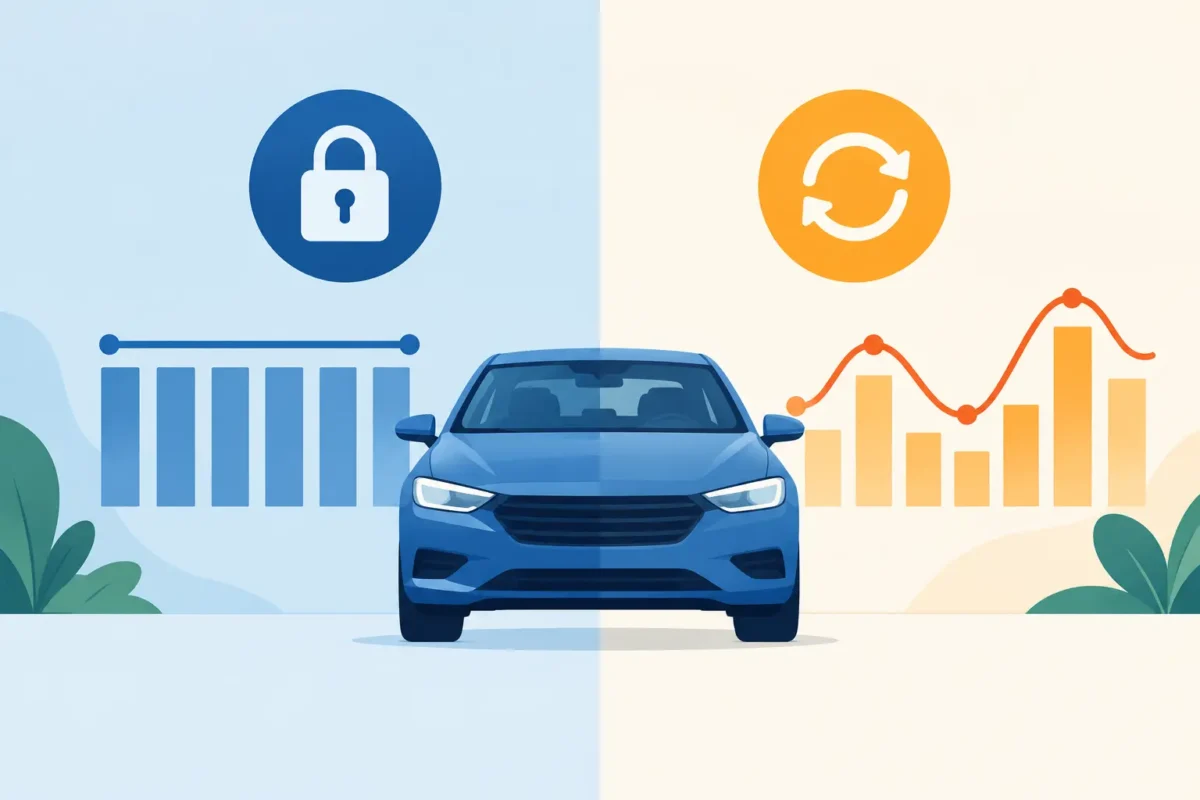
The difference comes down to certainty versus flexibility. A fixed rate gives you a stable APR and payment schedule. A variable rate gives you the possibility of a lower rate at the beginning, along with the possibility that your costs will increase later.

Neither option is automatically right for every borrower. Your choice depends on your financial priorities, how long you expect to keep the loan, and how much payment change you could realistically handle.

A fixed rate often makes sense when you want to know what your car will cost every month. It can be a strong fit for drivers with a tight budget, families managing several bills, or borrowers who plan to keep their refinance loan for years.

A variable rate may be worth considering only if you understand the adjustment rules and have enough financial flexibility to handle a higher payment. It may also be more attractive to someone who expects to pay off the loan very quickly, before a rate adjustment has much time to affect the total cost. Even then, compare the terms carefully instead of assuming the lower starting rate will save money.

Your APR Is Not the Only Number That Matters

When you refinance, focusing only on the advertised rate can lead to an incomplete comparison. Your payment and total loan cost are shaped by your APR, loan balance, repayment term, and any applicable fees.

For example, extending your repayment term can lower your monthly payment even if the interest rate does not drop much. That can create useful breathing room in your budget. But a longer term may also mean paying more total interest over time. On the other hand, a shorter term can help you pay the vehicle off faster, but it may raise your monthly payment.

The best refinance offer is the one that supports your actual goal. If your priority is immediate monthly savings, a longer term and competitive fixed APR may help. If you are trying to reduce total interest, a shorter term could be the better move if the payment still feels comfortable.

Compare offers using the same loan details

To make a fair comparison, look at each offer using the same remaining balance whenever possible. Then review the APR, monthly payment, number of payments remaining, total estimated interest, and any fees. If one lender quotes a lower payment, check whether it is because of a better rate, a longer term, or both.

Also consider your current loan. If your credit has improved since you financed your vehicle, or if market conditions have changed, refinancing could give you access to better terms than you received at the dealership.

When Refinancing With a Fixed Rate May Help

Refinancing may be worth exploring if your current rate feels high, your payment is straining your budget, or your financial profile has improved. A fixed-rate refinance can help replace uncertainty with a payment you can plan around.

You may want to get a refinance quote if you have been making on-time payments, paid down part of your existing balance, improved your credit, or found that your original loan term no longer fits your needs. You do not have to wait until your current loan becomes unmanageable. Comparing options early can give you more choices.

Keep in mind that refinancing restarts your loan with a new term. If you choose a longer term to lower your payment, make that decision intentionally. Lowering the monthly obligation can be valuable, especially when cash flow is tight, but it is smart to understand the total repayment picture before you finalize anything.

Questions to Ask Before You Choose

A clear loan offer should make it easy to understand what you are agreeing to. Before moving ahead, ask whether the rate is fixed or variable, whether the quoted APR includes applicable fees, and what your payment will be from the first month through the final payment.

If the rate is variable, ask what could cause it to change and how high it could go. If the rate is fixed, confirm that the rate will remain fixed for the entire loan term. You should also ask whether there is a prepayment penalty. Many borrowers like having the option to pay extra toward principal when their budget allows.

The right lender should give you room to review your options without pressure. OpenRoad Lending focuses on making the refinance process easier to understand, so you can evaluate a potential payment and term with your own financial goals in mind.

Choose the Payment You Can Live With

A car loan should support your life, not make every month harder to manage. Fixed versus variable auto rates is not just a technical finance question. It is a decision about how much certainty you want in your budget and how much risk you are willing to take for a potentially lower starting rate.

If a stable payment would help you feel more in control, a fixed-rate refinance may be the better fit. Take a few minutes to compare your current loan with available refinance terms, then choose the option that gives your budget more room to move.

Read more
Can You Refinance Before First Payment?

Can You Refinance Before First Payment?

Your first auto loan statement may not have arrived yet, but the payment already feels too high. Maybe the dealer-arranged financing came with a rate you did not expect, or you have since found that a lower payment would give your budget more breathing room. It is possible to refinance before first payment, but timing, lender rules, and the details of your current loan all matter.

Moving quickly can make sense when the new loan offers a meaningful improvement. Still, refinancing is not automatically the right move just because a better rate appears. The goal is to find a loan that supports your monthly budget and your long-term borrowing costs without creating avoidable delays or fees.

Can You Refinance Before First Payment?

In many cases, yes. Some auto refinance lenders will consider an application soon after you purchase your vehicle, even before your first scheduled payment is due. Other lenders require your existing loan to be open for a certain period, such as 30, 60, or 90 days. Policies vary, so an early refinance depends on the lender you choose and whether your current lienholder can provide the information needed to complete the payoff.

Your new lender generally needs to verify the existing loan, vehicle, borrower information, and payoff amount. Right after a purchase, your original lender may still be processing the account. The lien may not yet appear in all systems, and the account number or final payoff information may not be available immediately. That administrative timing is often the biggest hurdle, not your ability to qualify.

A refinance application also does not erase your responsibility for the original loan until the payoff is complete. If your first payment comes due while the refinance is being finalized, make that payment on time unless your current lender confirms otherwise. A missed payment can hurt your credit and create extra stress during a process meant to improve your finances.

When Early Auto Loan Refinancing May Make Sense

Refinancing early may be worth considering if your dealer financing was a temporary solution rather than your best available option. Dealerships can make buying a vehicle more convenient, but the financing offer you accepted may not be the most competitive loan available to you.

You may also be in a better position than when you applied at the dealership. Perhaps you had limited time to shop rates, made a larger down payment than expected, paid down another debt, or corrected an error on your credit report. Even a modest rate reduction can help, especially when combined with a loan term that better fits your payment goals.

The monthly payment matters, but it should not be the only number you compare. Extending your repayment term can lower the payment while increasing the total interest you pay over time. A lower rate with a similar or shorter term can be especially valuable, but the best choice depends on your cash flow, vehicle value, remaining balance, and how long you plan to keep the car.

A quick example

Suppose you financed a vehicle at a rate that leaves you with a $620 monthly payment. A refinance offer could lower that payment by reducing the interest rate, extending the term, or both. Lowering the payment can provide real relief, but review the new payoff date and total finance charge before deciding. Saving $75 a month is helpful. Paying substantially more interest over several additional years may not be.

What Lenders Look At Before Your First Payment

Applying early does not mean lenders skip the standard refinance review. They still evaluate whether the loan and vehicle meet their guidelines. Your credit profile, income, debt obligations, loan balance, vehicle age and mileage, and payment history can all play a role.

Because a brand-new loan may not yet show a payment history, lenders may focus more closely on your overall credit and the vehicle’s value compared with the amount you owe. If you rolled taxes, warranties, negative equity from a previous vehicle, or other costs into the loan, the balance may be high relative to the car’s current value. That can limit refinance options, particularly right after purchase when depreciation may occur quickly.

Your loan documents can help you prepare. Have your current lender’s name, account number, vehicle identification number, current balance, loan term, rate, and payment amount available. If you have not received your first statement, your retail installment contract may contain much of this information. The lender processing your refinance may request additional documentation to confirm the final payoff.

Watch for These Early Refinance Trade-Offs

A new rate can look appealing, but read the terms carefully. Start by checking whether your current loan includes a prepayment penalty. These are less common on auto loans than they once were, but you should confirm before moving forward. If there is a penalty, compare it with the savings you expect from refinancing.

Also look for fees on the new loan, including title transfer or state-related charges where applicable. Ask how the lender handles any optional products added to the original financing, such as a vehicle service contract, GAP coverage, or other protection products. Depending on the product and its terms, you may have options to keep coverage, cancel it, or receive a refund of any eligible unused portion. Do not assume refinancing automatically cancels or transfers coverage.

Finally, be realistic about how much time has passed. If your original lender has not set up the account yet, applying immediately may lead to a delay or a declined application based solely on account seasoning requirements. Waiting a few weeks may give the original loan time to become fully active and make the refinance process easier.

How to Refinance Before Your First Payment Without Missing a Beat

Start with the numbers you have. Review your purchase contract and identify your current annual percentage rate, monthly payment, remaining term, and approximate financed amount. Then decide what improvement matters most to you: a lower payment, a lower rate, a shorter payoff timeline, or a better balance among all three.

Next, get a refinance quote from a lender that works with your vehicle and loan situation. A reputable lender should make the terms clear enough for you to compare the proposed payment, rate, term, and estimated total cost. OpenRoad Lending helps eligible drivers explore auto refinance options through a straightforward online process, with support available when questions come up.

Once approved, follow the new lender’s instructions and keep your original loan current. Do not cancel automatic payments or assume your old lender has been paid off until you receive confirmation. After the payoff posts, verify that the original account shows a zero balance and that your title and insurance information are updated if needed.

Questions to Ask Before You Accept

Before signing a new loan agreement, make sure you can answer a few practical questions. What will the new monthly payment be? How many months will you be paying? What is the APR? Is there a prepayment penalty or any refinance-related fee? How soon can the new lender pay off the original loan?

You should also ask whether the first payment on the new loan will be due before or after the original loan’s next due date. Understanding that timing helps you avoid the most common early-refinance mistake: thinking one loan payment replaces the other before the payoff has actually occurred.

A Better Payment Can Start Sooner Than You Think

You do not have to wait until months of payments have passed to see whether your auto loan still works for your budget. If your current rate or payment feels out of step with your needs, an early refinance quote can show you what may be possible. Just keep the original account current, compare the full loan terms, and choose the option that gives you useful savings without stretching your repayment timeline farther than you want.

Read more